by Dominique Marshall
This blog was first published in the Landon Pearson Centre Newsletter, June 2026/Spring
A Treasure of Documents about Canadian & Transnational Childhood Histories
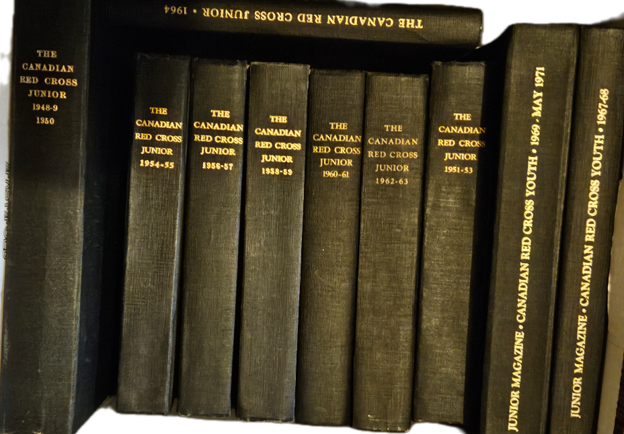
A sample of the 45 volumes donated by the Canadian Red Cross. Photo by D. Marshall.
At the peak of its popularity, in the late 1950s, the CJRC counted one out of four Canadians between 5 and 19 years old amongst its members. One of the first association of its kind, the youth branch of the Canadian Red Cross Society belonged to an international movement that reached dozens of countries (3). The historian of the movement, Sarah Glassford, writes that “the Junior Red Cross (JRC) program of the 1920s and 1930s aimed to teach school-aged children and youth habits of good health, good citizenship, and service to others.
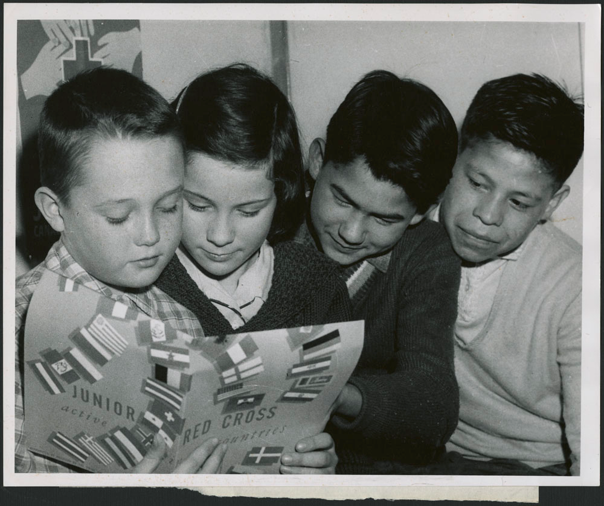
Group of unidentified children looking at a Junior Red Cross book, ca. 1950-1960. Library Archives Canada.
Inspired by a transnational ethic of humanitarianism, the program tried to build international ties of friendship between JRC members in Canada and those elsewhere, while shaping Canadian Juniors in a particular mould of national citizenship (4). “Teachers who chose to adopt the Junior Red Cross program usually devoted one or more Friday afternoon classes per month to its activities. Students elected officers and followed parliamentary procedure, directing their own work with light guidance from their teacher. A national Junior Red Cross magazine and health-related resources for teachers supported the program.” (5). Produced by adults in Ottawa, the magazines reported on children’s activities, including chapters of the Canadian Junior Red Cross (CJRC) in Indigenous schools.
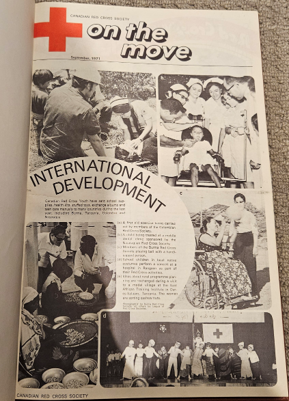
On the Move, September 1971, p. 1
Photo by D. Marshall.
Glassford has also written about the tensions the conflicting ideals of peace and patriotism created amongst school communities and these publications have a lot to say about changing ideals and understandings of international relations
amongst Canadian adults.
I handed out these copies of On the Move to the students of a third-year course I teach at Carleton University, on the history of humanitarianism. During this archival workshop, one group discovered the model for a paper doll of Princess Tsehai Haile Selassie of Ethiopia, complete with a small history of her achievements. One of the pioneers of Ethiopia’s modern nursing program in the 1940s, Tsehai was at the centre of one article I had written a few years before (7). The opportunities to study children’s representations, activities and expressions, are infinite.
For a full list of references access the following link: https://canva.link/dominique-marshallblog2026


Leave a Reply