Category: Uncategorized (Page 1 of 5)

CNHH Panel at CHA Congress 2026

by Jill Campbell-Miller

On June 1, 2026 the Canadian Network for Humanitarian History (CNHH) sponsored the panel “Tools for Peace, Solidary Movements, and Archives in Emergencies” at the Canadian Historical Association-Société historique du Canada (CHA-SHC) Annual Meeting. The CNHH is approaching ten years of being an affiliated committee of the CHA-SHC, bringing together scholars who examine themes related to Canada’s history in the humanitarian space.

This year’s panel included two presentations by founding members of the CNHH, Dominique Marshall and Kevin Brushett. A third planned presenter, David Webster, was in Timor-Leste in March and June to work with members of the new Department of History at their National University (UNTL). Supported by a UNESCO contract, Webster helped the Department draft a strategic plan and acquire resources, including books on History for the UNTL library. A new series of historical books by Timorese historians is also in the works after this project.

Dominique Marshall, “Stewardship, Preservation and Uses of Refugee Archives in a Time of Disappearance, Corruption and Technological Obsolescence:  Strategic Work and Ideas at the Humanitarian Archive Emergency Project”

Dominique Marshall has been leading efforts within Canada to preserve and archive the records of organizations and people working within humanitarian organizations and government in Canada for many years. That work brought her to connect with the Humanitarian Archive Emergency (HAE) at Manchester University. Bringing together Information Technology specialists, development aid workers and volunteers, librarians, archivists, and historians linked to humanitarianism, this group is working to respond to the drastic cuts of the United States Agency for International Development (USAID), United Nations High Commission of Refugees (UNHCR) and the International Committee of the Red Cross (ICRC). As the many organizations impacted by these cuts refocused to “food and shelter” issues, the administrative and record-keeping aspects of their works has been put aside. Access to data sets maintained by organizations such as USAID were suddenly cut off, as was access to archives.

The HAE is stepping in where possible to save records at risk of disappearing. Though historians may immediately think about the practical consequences of this work, this group has consciously focused on the ethical implications of archival disappearance. Such mass disappearance is characterized by the HAE as a betrayal of trust, both to those that entrusted their information to such organizations while accessing any services they provide, and to the donors and public at large who contribute through taxes. From there, Dominique discussed individuals involved in the project who represent the various facets of the group’s expertise, and their individual areas of focus, which range from academics using large datasets for research to former practitioners with on-the-ground experience in the field. She also summarized the HAE’s future plans, which includes holding four workshops in the Global South to provide humanitarian workers with training around the tools and frameworks of maintaining depositories of information.

Kevin Brushett, “Tools for Peace: Canadian Solidarity Movements & the Wars for Central America, 1979-1991”

The second presentation by Kevin Brushett (whose book Mirrors of a Generation: The Company of Young Canadians, Youth Activism, and Community Development: 1965-1976 was recently released by McGill-Queen’s University Press) delved into the history of the “Tools for Peace” (T4P) movement, a Canadian effort to support the Sandinista Revolution in Nicaragua through the 1980s and early 1990s. Though the Sandinistas had overthrown the Somoza dictatorship in Nicaragua in the late 1970s, the Revolutionary government continued to face challenges in implementing their socialist policies of reform, not least due to the US-supported counter-revolutionary forces that worked against them as well as the cancellation of US aid to the country. Brushett argued that the Tools for Peace movement formed a broad-based coalition across political lines in Canada, partly attracted by a shared sentiment against US imperialism. At its height, T4P had 125 chapters across the country. Its origins are in the British Columbia Labour movement in Canada, whose members toured Nicaragua in 1981 and found a void that they thought could be filled with “people-to-people” solidarity. They founded the “Boat Project,” and filled a boat with goods that were delivered to Nicaragua, beginning an annual campaign collecting money and material goods. This initial effort brought in a broad-based coalition including organizations such as CUSO, women’s groups, churches, and labour. Working directly with the Sandinista government to determine which goods which be collected and how they would be distributed, T4P attracted interest from what might seem like unlikely parts of the country, including the union-centric Cape Breton coal miners. These miners found common cause with Nicaraguans from their own experiences, having experience with their lives being controlled by outside corporate interests. Official Canadian policy, meanwhile, tacitly supported the Revolution in the hopes of avoiding a “second Cuba.”

Though broadly-based, T4P was not without its challenges. One issue that Brushett found in the records was a mismatch between what the Sandinista government or Nicaraguans wanted, and what Canadians were willing to give. Medical supplies arrived expired, or equipment was unrepairable due to a lack of replacement parts. Another issue was a mismatch between the on-the-ground volunteers and the organizers. While there were plenty of volunteers, there were few willing to organize, and the “same twelve people” ended up carrying the load of the administrative and practical work of the shipments. The final blow came in 1990 election, when the Nicaraguan population voted against the Sandinistas. Brushett described how some Canadian organizers felt betrayed by this shocking election result, after giving much of their personal time and resources to the T4P Movement. Despite this, it was not until 1996 that the final T4P committees in Ontario folded.

Brushett’s work was made possible by the organizers of the T4P who donated their papers to the William Ready Archives at McMaster University Archives, and he’s recently learned of a second group of materials in British Columbia. His ability to write about this important, broad-based movement that reached across Canadian society and geography is a direct result of the donors who had the foresight to know that what they had was worth preserving, and the archivists who maintain the collection. In this way, the CNHH panel this year reached across the discipline by reminding us of what is lost when such records disappear, and what is richly gained when they are available.

CNHH members are already looking ahead to the next CHA-SCH Annual Meeting, which will be held in Winnipeg. If you are interested in contributing to a panel, please get in touch at aidhistory.canada@gmail.com
Message to the Membership: CNHH Member John Foster Passed Away, Saturday April 18th, 2026

I received the news the day before I welcomed twenty-five high school teachers at the Archives & Special Collections (ASC) of Carleton University to introduce them to working in archives. We worked with the collection of lantern slides of the Christian missionary work of the pre-union Methodist and Presbyterian churches in South China John gave to ASC eight years ago. We also had boxes of the general fonds of his papers, about his Oxfam work, the making of his thesis, etc.


John was one of the most productive humanitarian veterans of the Canadian Network on Humanitarian History. He put many of us in contact with each other, attended events with curiosity and generosity. This led to a wonderful exhibit and event by and about Chilean exiles organised by his friend Leonore Leon José Venturelli Eade’s art exhibit at Carleton University (March 2018). The CNHH chronicled the moment John received a distinction: Canadian Veteran Humanitarian Honoured by Chilean Embassy of Ottawa (November 2016), helped along the project of archiving his work (New Additions to the John William Foster Fonds (November 2017); (re) published his piece on his friend George Cramm (George Cramm (1938-2018), Canadian Humanitarian: Veteran of the Latin American Working Group – (April 2018); assisted in the making of the Latin American Working Group (LAWG) library at CERLAC’s Resource Centre (March 2017).


I, and the members of the CNHH with me, will miss him immensely. We hope that, from our end, we can contribute to make sure that his work will be remembered, researched and rediscovered by all who work, like him, for justice and solidarity.


Dominique


Read the obituary published by the Globe and Mail.


CNHH-Sponsored Book Launch for The NGO Moment: The Globalisation of Compassion from Biafra to Live Aid

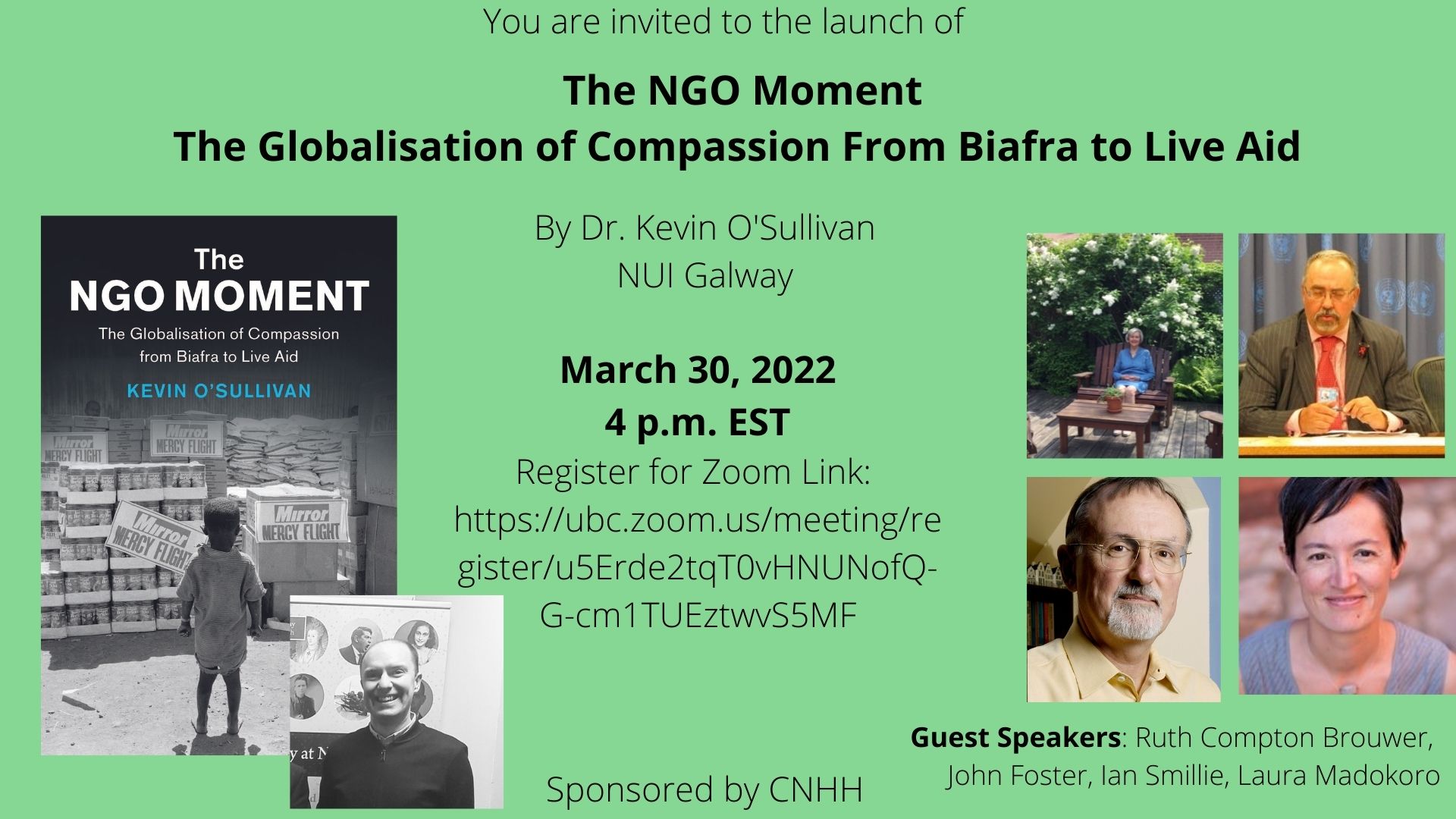
You are invited to celebrate the CNHH-sponsored launch of Dr. Kevin O’Sullivan’s book The NGO Moment: The Globalisation of Compassion from Biafra to Live Aid. Join us on zoom on March 30 at 4 p.m. EST! Guest Speakers include: Dr. Ruth Compton Brouwer, Dr. John W. Foster, Dr. Laura Madokoro, and Dr. Ian Smillie. Register for the zoom link here: https://ubc.zoom.us/meeting/register/u5Erde2tqT0vHNUNofQ-G-cm1TUEztwvS5MF

CNHH Presents: Essential Reads in the History of Humanitarianism

Top 6 English-language Works on Children and Humanitarian Aid

~ as recommended by Dominique Marshall, September 2021~

~ With an introduction by Sarah Glassford ~

Although some of the modern world’s earliest humanitarian movements and organizations revolved around adult concerns such as the immorality of chattel slavery or the devastation of war, children quickly emerged as a central focus of certain humanitarian efforts and as powerful ambassadors of need in many others. As Karen Dubinsky writes, children “are as rich in symbolism as they are short on power,”[1] making their perceived suffering an excellent means of mobilizing support for fundraising and awareness campaigns. But they are also people with a degree of agency, who experience their times and circumstances – and the aid thrust upon them – in ways that do not necessarily follow the roles ascribed to them.

What follows is a shortlist of English-language works – some classic and some more recent – that innovatively and sometimes movingly explore the ways children at home and abroad have been recipients, donors, and symbols of humanitarian aid.

Dr. Marshall’s (current) top 6 essential reads, in order of publication:

1. Joy Parr. Labouring Children: British Immigrant Apprentices to Canada, 1869-1924. Montreal: McGill-Queen’s University Press, 1980.

This classic study of orphaned and working-class British children sent to Canada as apprentices and adoptees provides a very well-rounded view of the (not always positive) outcomes of child-saving adults’ good intentions and authority. It also emphasizes the impact of class on childhood – particularly for the children of the poor.

2. J.R. Miller. Shingwauk’s Vision: A History of Native Residential Schools. Toronto: University of Toronto Press, 1996.

Another classic study, this one is about assimilationist institutions for Indigenous children that were claimed in their time to be a form of Canadian humanitarianism at home. Although there are now more recent, and more critical, works on the residential schools, Miller’s chapter on the resistance of the children is still full of meaning and good questions.

3. Erica Bornstein. The Spirit of Development: Protestant NGOs, Morality, and Economics in Zimbabwe. New York: Routledge, 2003.

An anthropological and sociological study of two religious, transnational NGOs in Zimbabwe, Bornstein’s study offers an excellent on-the-ground view of the roles of both sponsors and sponsored children/families, that prompts new ways of thinking about humanitarian images, actions, and consequences.

4. David M. Rosen. Child Soldiers in War and Terrorism. Rutgers Series in Childhood Studies. New Brunswick, NJ: Rutgers University Press, 2005.

The question of child soldiers is all too often oversimplified. Rosen’s study unpacks the many complicated dimensions of this phenomenon, including how a variety of political groups in Africa have argued in different ways for the rights of children, and the decisions made by children themselves.

5. Karen J. Sanchez-Eppler. “Copying and Conversion: An 1824 Friendship Album ‘from a Chinese Youth.’” American Quarterly 59, 2 (2007): 301-339.

Sanchez-Eppler’s careful study of a friendship album created at a Connecticut school that trained “heathen” youths to be foreign missionaries, interpreters, doctors, and teachers is a wonderful model for how to approach and mine primary sources for evidence of children’s expressions and emotions – even in what might appear to be conventional copy-work or formulaic sentiments.

6. Matthew Hilton. “Ken Loach and the Save the Children Film: Humanitarianism, Imperialism, and the Changing Role of Charity in Postwar Britain.” The Journal of Modern History 87, 2 (2015): 357-394.

Hilton’s valuable article examines the first fifty years of Britain’s Save the Children through the lens of a 1969 documentary by Ken Loach that framed SCF’s work in Africa as a form of imperialism. The Loach film and Hilton’s article both highlight how domestic social policies and humanitarian endeavours proceed from the same attitudes. There is much more to say in this area – for instance, with respect to the teaching of lip-reading (rather than sign language) to deaf children, as documented in Lindsay Anderson and Guy Brenton’s 1954 short documentary Thursday’s Children (about The Royal School for the Deaf in Margate, UK).

_____________________

Dr. Dominique Marshall is Professor of History at Carleton University, where she teaches and researches the histories of social policy, children’s rights, humanitarian aid, refugees, disability, and technology. She is the founder and coordinator of the Canadian Network on Humanitarian History, and served as president of the Canadian Historical Association 2013-2015. Her book, Aux origines sociales de l’État providence (1998) [available in English as The Social Origins of the Welfare State (2006)] received the Jean-Charles Falardeau Prize (now Canada Prize) from the Canadian Federation of Social Sciences and Humanities. Among many other organizations and projects, she is a member of the advisory board of Resilient Humanitarianism funded by the Australian Research Council, and of the teaching website Recipro: the history of international and humanitarian aid

Dr. Sarah Glassford is the Archivist in Leddy Library’s Archives & Special Collections at the University of Windsor, and a social historian of modern Canada whose published works include Mobilizing Mercy: A History of the Canadian Red Cross (2017). She would like to officially thank Dominique for introducing her to the formal study of humanitarian history (ca. 2008, when Sarah was a postdoctoral fellow at Carleton’s neighbouring institution, the University of Ottawa) and for looping her into many shared projects and networking opportunities ever after.


[1] Karen Dubinsky, “Children, Ideology, and Iconography: How Babies Rule the World,” Journal of the History of Childhood and Youth 5, 1 (2012): 8.

Agenda – AGM June 4, 2021

  1. Introductions
  • CHA Panel:
  1. 2021 – update
    1. 2022 planning
  • Updates on CNHH projects
  1. Report from ongoing MITACS projects (Anna, Helen, Elizabeth)
    1. David Webster
    1. Archival Rescue
    1. Teaching…Recipro, upcoming courses, and other projects.
  • News from overseas partners
  • Future projects:
    • NGO partners
    • Funding
    • Training
  • Housekeeping:
    • Website overhaul
    • Governance update
    • Membership update and potential new members
  • New Business

Launch of Recipro Teaching Website

Inéz Petrazzini, research assistant and a student in International Development at the University of Ottawa, talked about Recipro at the Shared Online Projects Initiative (SOPI) Showcase Event on April 29, 2021. The celebration was hosted by Dr. Aline Germain-Rutherford, Vice-Provost, Academic Affairs, University of Ottawa and Dr. David Hornsby, Associate Vice-President, Teaching and Learning, Carleton University. Developed by an inter-university partnership that includes the participation of students in courses in History and Sociology, the Recipro website project focuses on the history of international solidarity and centres on the convergence of pedagogy, science, and digital humanities.

You can watch the video here: https://mediaspace.carleton.ca/embed/secure/iframe/entryId/1_614uy931/uiConfId/36153741


Inéz Petrazzini is a third-year student completing an honours bachelor’s degree in International Development and Globalization (CO-OP) at the University of Ottawa. She worked as a Research and Teacher’s Assistant and Webmaster on the Recipro team. Her responsibilities included guiding students with their digital projects, building, developing, and updating the Omeka website, creating and contributing content for the Recipro project, as well as cataloguing, translating, and migrating content provided by the mentioned professors onto Omeka. Some of her interests include global politics, sustainable development projects, digital humanities, visual arts, and music.

The original video describing the Recipro Project can be found on the Recipro website and on their About Us page.

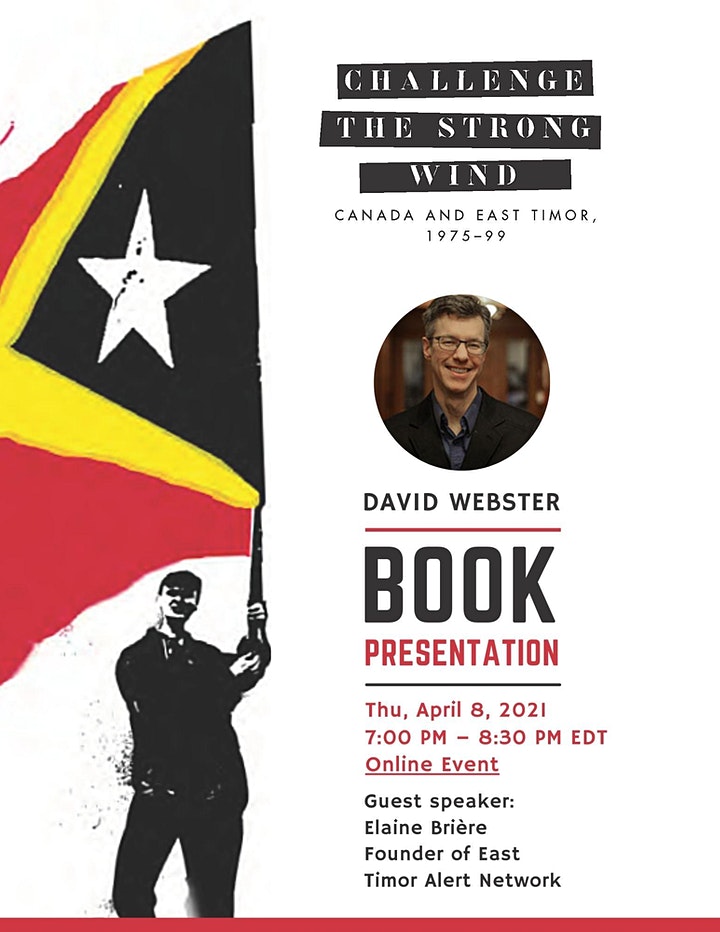
David Webster Launches Challenge the Strong Wind: Canada and East Timor, 1975-99 with UBC Press

You can find the video for this talk at the link below:

https://mediaspace.carleton.ca/media/Challenge+the+Strong+Wind+book+launch+talks/1_dirpc60m

In 1975, Indonesian forces overran East Timor, just days after it had declared independence from Portugal. Canadian officials knew the invasion was coming and initially endorsed Indonesian rule. The ensuing occupation of the Southeast Asian country lasted twenty-four years.

Challenge the Strong Wind recounts the evolution of Canadian government policy toward East Timor from 1975 to its 1999 independence vote. During this time, Canadian civil society groups and NGOs worked in support of Timorese independence activists by promoting an alternative Canadian foreign policy that focused on self-determination and human rights. After following the lead of pro-Indonesian allies in the 1970s and ’80s, by the 1990s Ottawa had yielded to pressure from these NGOs and began to make its own decisions, eventually pushing like-minded countries to join it in supporting Timorese self-rule.

David Webster draws on previously untapped archival sources to articulate both government and non-government perceptions of the crisis. Human rights, competing nationalist claims, and peacemaking – key twentieth-century themes – intersect in East Timor, and the conflict provides a model of multilevel dialogue, citizen diplomacy, and novel approaches to resolving complex disputes. Ultimately, Webster criticizes the Canadian government for complicity in a near genocide, demonstrating that a clear-eyed view of international history must include non-state perspectives.

This sharply drawn work will be required reading for scholars studying Canadian history, foreign policy, international relations, human rights, Southeast Asia, and social activism.

Purchase Challenge the Strong Wind from UBC Press.

Dr. Sarah Glassford and Women in the Red Cross during World War II

Rob Blanchard Photo UNB

In this interview with Dr. Samantha Cutrara, Dr. Glassford talks about a letter sent home from London in 1943 to demonstrate how prominent emotional labour and creating networks of home was for many women in the Red Cross. We talk about gender, and gendered expectations of care and service during the war, and how women’s experiences and expectations may have grated against these.  This interview discusses the use of primary sources, women and WWII, and largely about emotions and caring through the lens of the Canadian Red Cross’ overseas humanitarian work.

Note: This conversation was recorded early in the COVID-19 pandemic.

The audio podcast can be found here.

Buy Making the Best of It here:
https://www.ubcpress.ca/making-the-best-of-it

More about Sarah: Sarah Glassford is a social historian and an archivist in the Leddy Library at the University of Windsor. She is the author of Mobilizing Mercy: A History of the Canadian Red Cross, and co-editor of A Sisterhood of Suffering and Service: Women and Girls of Canada and Newfoundland during the First World War.

Learn more about Dr. Samantha Cutrara at https://www.SamanthaCutrara.com/

Order Transforming the Canadian History Classroom: Imagining a New ‘We’: https://www.ubcpress.ca/transforming-the-canadian-history-classroom

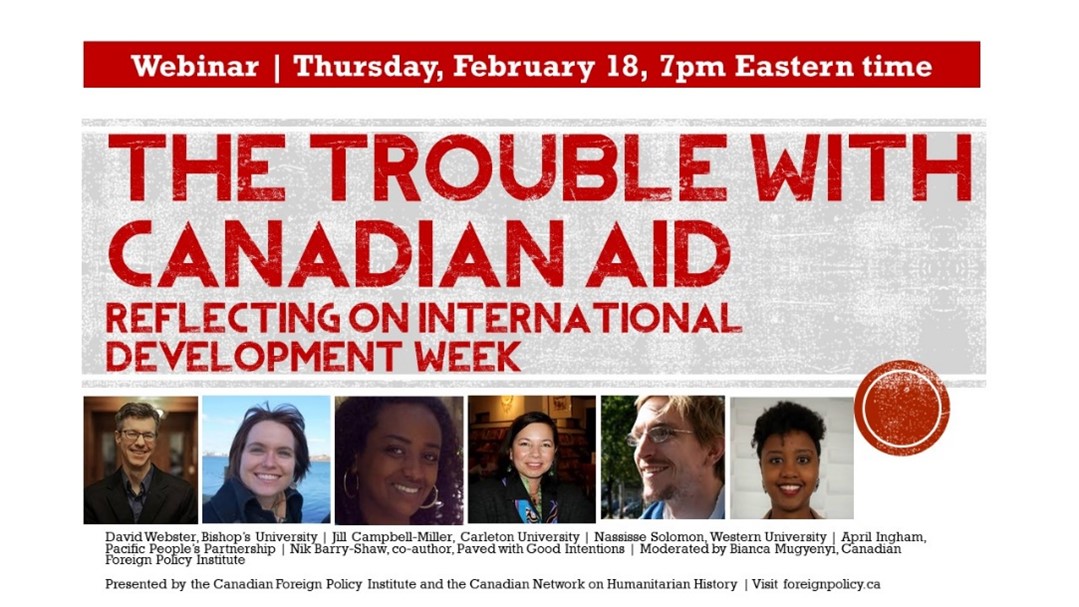
The Trouble with Canadian Aid: Reflecting on International Development Week

Held in mid-February 2021, this webinar was sponsored by the CNHH featuring five academics coming together from different aspects of Canadian foreign policy and aid relations: David Webster (Bishop’s University), Jill Campbell-Miller (Carleton University), Nassisse Solomon (Western University), April Ingham (Pacific People’s Partnership), Dru Oja Jay (co-author Paved with Good Intentions), and moderated by Bianca Mugyenyi (Canadian Foreign Policy Institute).

Due to Facebook policy regarding embedded video, please follow the link below rather than the Play Video button.

https://www.facebook.com/watch/?v=423733052218132

« Older posts