Recently, an article published on the University of Waterloo’s website recognized the achievements of CNHH member and professor at St. Mary’s University in Halifax, Dr. Jill Campbell-Miller. Her dissertation, “The Mind of Modernity: Canadian Bilateral Foreign Assistance to India, 1950-60,” was selected as a finalist for the Council of Graduate Studies/ProQuest Distinguished Dissertation Award. Visit the University of Waterloo website for the complete article including comments about her dissertation and experience from Dr. Campbell-Miller and her supervisor, Dr. Bruce Muirhead.
Author: Sean Eedy (Page 20 of 20)
The Canadian Network on Humanitarian History proudly announced the lauch of the Network’s new website with the release of its first newsletter to its membership. See the complete newsletter with recent posts, announcements and the activities of the Network below.
suggested by Andrew Johnston (Network member)
Sara Fieldston. Raising the World: Child Welfare in the American Century. Cambridge: Harvard University Press, 2015. . $39.95 (cloth), ISBN 978-0-674-36809-5.
Reviewed by Karen Dubinsky (Queens University)
Published on H-Diplo (September, 2015)
Commissioned by Seth Offenbach
Sara Fieldston’s Raising the World: Child Welfare in the American Century helps to build the case, now made by many scholars, for considering foreign policy from the bottom up, wresting our conceptualization of international relations from the world of men-in-suits and dispersing it, as it should be, through various sectors of the population. It is also an important contribution to the historiography of childhood and child welfare, a component of international relations. These are not well-trod paths but they are not new territory either. Where Raising the World says something very new is in its suggestive, at times impressionistic, discussion of the links between the post-World War Two project of “Third World Development” and childhood.
by Sean Eedy
In the current climate surrounding the refugee crisis in Europe, the European Union is struggling not only with the relocation of these refugees, but also with feeding and housing these refugees and who should pay for it all. At the moment, Germany seems to be the preferred destination of the majority of these refugees and, given the relative economic strength of Germany in Europe and their leading position in EU affairs and institutions, this may perhaps be the most tenable situation. Germany has a system in place to resettle these refugees across the state in proportion to the ability of each Laend to sustain them, but this will become taxing on even the strongest economy and requires the aid of supranational institutions and NGOs. This migrant crisis and the accompanying stresses on German infrastructure have since sparked resurgence in Neo-Nazi activity even before the November 2015 attacks in Paris and Beirut.
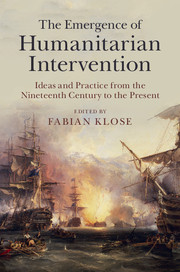
Cambridge University Press recently published a new volume on humanitarian aid and intervention of potential interest to the community. Edited by Dr. Fabian Klose of the Leibniz-Institut fuer Europaeische Geschichte, Mainz, The Emergence of Humanitarian Intervention: Ideas and Practice from the Nineteenth Century to Present presents articles by academics including Michael Geyer, Daniel Marc Segesser, Stefan Kroll, and Mairi S. Macdonald.